Hilma af Klint Painted the Future. Then She Hid It for 20 Years.

There is a particular kind of loneliness in making something extraordinary and knowing, with some certainty, that the world is not ready for it.
Not the ordinary loneliness of making things, which most artists know well enough. This is something more deliberate. The decision to complete the work, protect it, and trust that time will close the gap between the making and the understanding. That is a specific act of faith, and very few people have had the patience for it.
Hilma af Klint had the patience for it. And then some.

Before the Abstract
To understand what Hilma af Klint did, it helps to understand what she was not supposed to do.
She was born in 1862 in Solna, Sweden, into a naval family with a tradition of mathematics. She trained at the Royal Academy of Fine Arts in Stockholm, graduating in 1887 with honours. By the standards of her time, this was extraordinary enough. Women were not commonly admitted to serious art institutions in late nineteenth-century Europe. That she was there, and that she excelled, was already a statement of something.
After graduation, she made her living the respectable way: botanical illustrations, portraits, scientific drawings. She was technically brilliant and commercially steady. Nothing in her professional output would have suggested what was coming. From the outside, she was exactly what the art world of 1890s Stockholm expected a trained woman artist to be.
Inside, she was doing something else entirely.
The Five and the Work That Nobody Saw
In 1896, Hilma and four other women, all trained artists, formed a group they called De Fem, or The Five. They were interested in spiritualism, in the invisible forces they believed shaped the material world, in contact with what they called the "High Masters." They held regular séances. They kept detailed notebooks.
For almost a decade, this was a private practice, separate from her public work. Then, in 1906, something shifted.
Hilma af Klint described receiving a commission. Not from a gallery or a patron. From a spiritual entity, she believed, called Amaliel, who instructed her to begin a series of large-scale paintings that would become a kind of temple. She began immediately, and largely alone, working in a state she described as automatic, with her hand moving almost independently across the canvas.
What emerged was unlike anything being made in Europe at that moment. Large, biomorphic forms. Spirals and cells and shapes that looked simultaneously like microscope slides and cosmological maps. A symbolic visual language she was inventing as she went. Vivid, strange, and absolutely her own.
She called the series "The Paintings for the Temple." Over the next several years, she completed 193 works in the cycle, the largest of which measured over three metres tall.
Here is the fact that matters: she finished the first major group of these paintings in 1906. Wassily Kandinsky, widely credited as the first abstract painter in Western art history, produced his first abstract watercolour in 1910, and published his theoretical treatise "Concerning the Spiritual in Art" in 1911. By four years at minimum, Hilma af Klint had arrived first.
She told almost no one.

Why She Hid Them
Rudolf Steiner, the philosopher and founder of anthroposophy whose ideas had influenced her deeply, visited her studio in 1908 and saw the paintings. His response, by her own account, was not encouraging. He told her the world was not ready for them. She appears to have believed him.
Whether that single conversation explains the decades of concealment is hard to say. More likely it confirmed something she already felt, that these works existed in a dimension her contemporaries lacked the framework to navigate. Cubism was being born in Paris.
Expressionism was fracturing in Germany. The art world was busy having its own revolutions, none of which left much room for a Swedish woman working alone in a private spiritual practice.
So she kept working, and she kept the work private. She showed it to almost nobody during her lifetime. She wrote extensively in notebooks, documenting the series, her intentions, the symbolic systems she had developed. When she died in 1944, at the age of 81, following a traffic accident, she left behind 193 paintings, 125 notebooks, and a stipulation.
The paintings were not to be shown publicly until at least 20 years after her death.
She had made something extraordinary. And she had decided, deliberately, to send it into the future.
The Long Wait
Her nephew Erik af Klint became the custodian of the estate. The 20-year mark came and went in 1964. There was no major reveal, no sudden recognition. The paintings sat in storage.
There was a small showing in Los Angeles in 1986, as part of a group exhibition on spirituality and abstract art. For people in that room, it was a revelation. For the broader art world, it landed quietly.
The Hilma af Klint Foundation, established to manage her legacy, continued its work. Scholars began to take the paintings seriously. The claim that she had preceded Kandinsky was documented and argued with growing rigour.
And then, in October 2018, the Guggenheim Museum in New York opened "Hilma af Klint: Paintings for the Future." It ran through April 2019. By the time it closed, more than 600,000 people had seen it, making it the most attended exhibition in the Guggenheim's history to that point.
People queued for hours. The gift shop sold out. Critics who had spent careers writing about the origins of abstraction found themselves reconsidering everything. A woman who had been almost entirely invisible to the mainstream art world for most of the twentieth century was, suddenly, everywhere.
She had been dead for 74 years.
What the Paintings Actually Look Like
Art history discussions of Hilma af Klint sometimes get so caught up in the chronology argument, who painted abstractly first, that they forget to talk about the work itself. That seems like the wrong order of priorities.
The Paintings for the Temple are not what you would expect if someone handed you a biography and said, "1900s, Sweden, spiritual practice, séances." They are not delicate or decorative or soft. They are enormous and confident and genuinely strange. The colours are bold, the forms are biomorphic and specific, the compositional choices are bold in ways that feel almost aggressive for their era.
Some of the series read like diagrams of forces the eye cannot normally perceive. Others feel warm and cellular, like looking at life at the scale where it organises itself. There is a precision to them that contradicts any suggestion of accident. She knew exactly what she was doing, even if she described the source as something beyond conscious control.
The notebooks help. She documented everything: the symbolic meanings of the colours, the relationship between forms, the structure of the series as a whole. The paintings were not meant to be experienced individually but as an environment, hung in a spiral temple that was never built. They are, in the fullest sense, a life's work.
The Patience of It
I think about Hilma af Klint often when I'm in conversations about visibility and timing and the question of when, exactly, the world is supposed to notice the work.
The art world has a very short attention span. Social media has made it shorter. There is enormous pressure on artists to be visible now, to be building an audience now, to be posting and pitching and connecting in ways that confirm the work exists. All of that matters, to some extent. But Hilma af Klint is a useful corrective.
She made over 190 paintings that nobody was allowed to see, across a period of several years. She documented them obsessively. She protected them. She sent them forward in time with the trust that the right moment would eventually arrive. And it did arrive, even if she wasn't alive to see it.
Lena Wigham, a Liverpool-based artist whose full interview you can read at artsloth.in/artist-archive, said something in her ArtSloth interview that connects to this directly. She spoke about collecting water and stones from places she swam and walked, and using them in her work, because she wanted the materials to carry the history of those places. She ended with this: "I hope my art long outlives me too."
That's it. That's the thing. Making work that is built to last, not work that is built to trend.

What It Changes
The art historical argument about Hilma af Klint and Kandinsky is not really about who deserves credit. It is about what we choose to see, and when, and whose story we build the history around.
The standard narrative of abstraction's origins was written by people who were not looking at her. The work existed. The notebooks existed. The timeline was verifiable. What was missing was the institutional will to look.
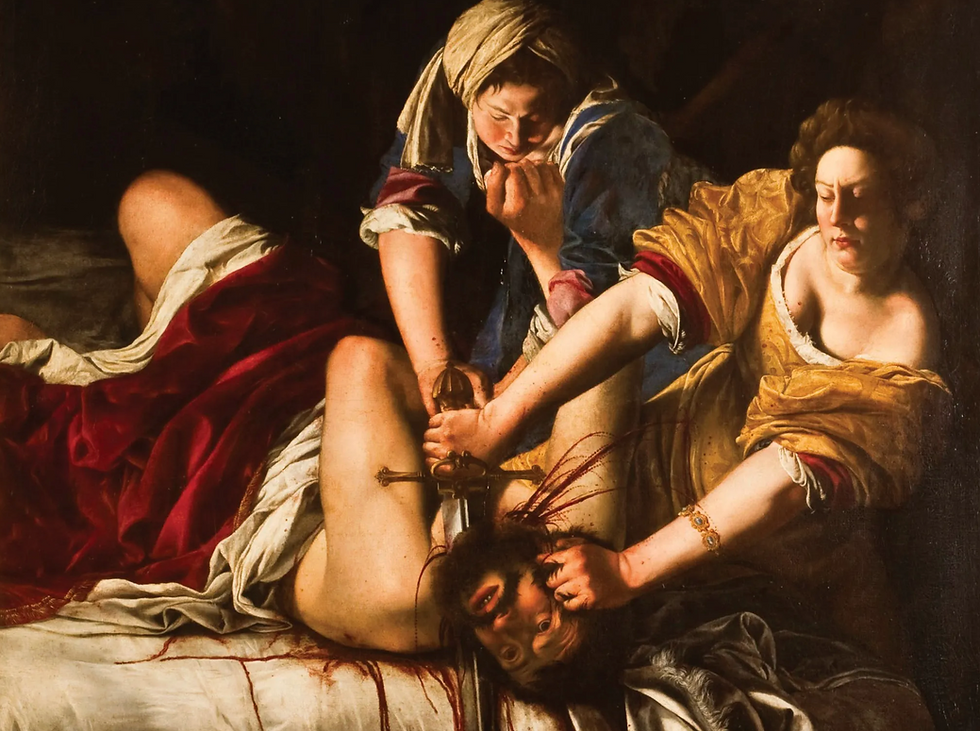
This is not unique to her. The history of art is full of artists whose work was present and visible and simply not encountered by the people who were writing the history at the time. The reassessment of Alice Neel, the rediscovery of Artemisia Gentileschi, the belated recognition of countless artists from traditions outside the Western European mainstream: all of these are stories of work that existed before the recognition arrived. You can read our piece on Artemisia Gentileschi if you want another version of this story, in a different century, with the same basic shape.
What changes when we take Hilma af Klint seriously, and the Guggenheim show proved that a very large number of people do take her seriously, is that we have to hold the history more loosely. We have to acknowledge that the absence of visibility is not the same as the absence of the work.
That distinction matters for living artists too. The archive we're building at ArtSloth is, in its small way, an attempt to document artists whose work exists but who don't have institutional backing. Not because we think we'll discover the next Hilma af Klint. But because the impulse behind her notebooks, the need to record the work, to give it a home, to send it forward, feels urgent and right.
The Question Hilma af Klint's Story Leaves You With
There is something in her story that is genuinely uncomfortable if you sit with it long enough. She was not discovered. She was always there. What changed was not the work. What changed was who was looking.
That puts a certain responsibility on institutions, on curators, on publications, on anyone with a platform. The question is not only "is this good work?" The question is also "are we looking in the right places?"
We try to ask both in the interviews we cover. We try to look at work from artists who haven't been through the established channels, who haven't had the institutional endorsement, who are making things in private and hoping someone will eventually look properly.
And if you're one of those artists, making work you believe in and wondering when the timing will be right: the Sloth Box is open. No fees. No gatekeeping. No requirement to already be recognised. Just you, and the work, and an honest set of questions about what it means to make it.
Hilma waited 74 years after her death for the world to catch up. We're not suggesting you do the same. But she proved, beyond any reasonable argument, that the work survives. That it matters. That it finds its moment.
Make the work. Trust the work. The rest follows.
Creative always,
One of the Sloths,