
Artemisia Gentileschi’s Judith Slaying Holofernes: A Masterclass in Resilience and Retribution

Updated: Feb 4
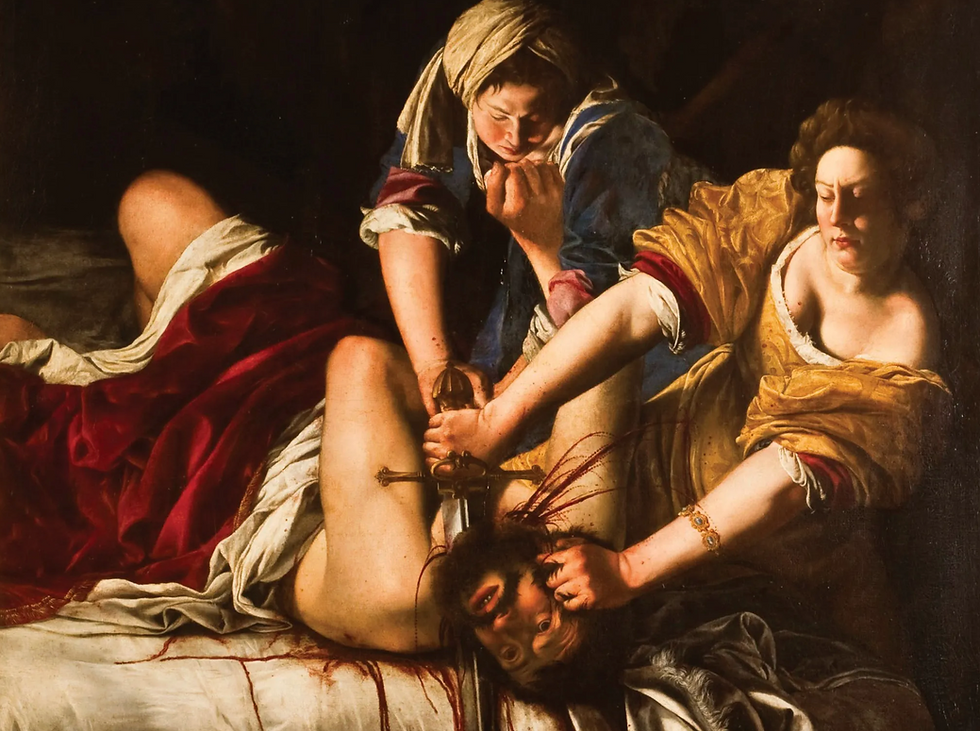
Artemisia Gentileschi’s Judith Slaying Holofernes is not just a painting; it is an explosion of visceral power, a technical marvel, and a historic act of defiance. Painted around 1612–13, it depicts the biblical story of a Jewish heroine beheading an Assyrian general to save her people from destruction. While many male masters of the Baroque era, most notably Caravaggio, tackled this same scene, Artemisia’s version stands alone. It is raw, bloody, and uniquely focused on the physical effort and female solidarity required for the act.
To look at this canvas is to witness a turning point in art history, a moment where a woman reclaimed the narrative of power and survival in an industry that sought to silence her.
The Human Behind the Masterpiece: A Voice Refined by Fire
To understand the weight of this painting, we must first confront the reality of Artemisia’s life. Born in Rome in 1593, she was the daughter of Orazio Gentileschi, a respected painter and friend of Caravaggio. In a 17th-century world that strictly forbid women from attending art academies or studying the male nude, Artemisia was a prodigy, training in her father’s studio from a young age.
However, her career and her spirit were nearly derailed by a horrific event. At the age of 18, she was raped by Agostino Tassi, a landscape painter hired by her father to tutor her in perspective. What followed was a public trial that would have broken most people. To "verify" her testimony, the court subjected Artemisia to a sibille—a form of torture where strings were wrapped around her fingers and tightened until they cut into the bone.
She stood her ground, repeating her truth even as she faced permanent damage to the very hands she used to paint. She won the trial, but the reputational damage in conservative Rome was immense. She didn't retreat, though. Instead, she moved to Florence, became the first woman admitted to the Accademia delle Arti del Disegno, and channeled the fire of her trauma into her work. Judith Slaying Holofernes is the ultimate visual manifestation of that survival.
Beyond Beauty: Analysis of Effort and Solidarity
In the male-authored versions of the Judith story, there is a recurring theme of "the delicate assassin." In Caravaggio's famous version, Judith looks almost repulsed by her own actions; she stands at a distance, her arms extended as if she wants to be as far away from the blood as possible. She looks like a girl performing a task she doesn't fully understand.
Artemisia Gentileschi’s Judith Slaying Holofernes is a revelation. She is not a delicate figure; she is a woman in the middle of a grueling, physical struggle. Her sleeves are rolled up to her elbows, revealing tensed muscles. Her brow is furrowed with professional determination, not disgust. She is leaning into the work, using her body weight to pin Holofernes down.
Perhaps the most revolutionary choice Artemisia made was the role of the maidservant, Abra. In traditional interpretations, Abra is an old woman waiting in the background with a basket. In Artemisia’s work, Abra is young, strong, and an active participant. She is shown pinning the general’s massive arms down, her own body straining under the effort. It is a portrait of female solidarity—two women working in tandem to overcome a singular, overwhelming threat. This shift in perspective—from a solitary "hero" to a collective act of resistance—is what makes the painting so modern.
Technical Mastery: The Drama of Blood and Light
Artemisia was a master of Tenebrism, a hallmark of the Baroque style that uses intense, suffocating darkness to make subjects "pop" with dramatic light. By shrouding the rest of the room in total shadow, she forces the viewer’s eye into the tight, claustrophobic space of the bed.
The blood in this painting is not stylized or "polite." It is violent and realistic, spurting in rhythmic arcs across the white bedsheets and onto Judith’s gold dress. This was a bold technical departure from the "clean" religious art of the time. Artemisia used her knowledge of the body to show how blood actually behaves, creating a sense of "sound" in the painting—you can almost hear the struggle.
The composition is built on a series of powerful diagonals. The arms of Judith and Abra form a "V" shape that leads the eye directly to the center of the conflict: the sword at the throat. This geometric precision creates a sense of inevitable force. The contrast between the soft, luxurious textures of the velvet blankets and the cold, hard steel of the sword emphasizes the intrusion of violence into a private space.
Symbolic Complexity: Reclaiming the Sword
In the 17th century, the sword was a symbol of male authority and judicial power. By placing the sword firmly in Judith’s hand, Artemisia was symbolically seizing that authority. Many historians believe the face of Holofernes is a direct likeness of Agostino Tassi, her rapist. Whether or not this was a literal "revenge painting," the symbolic weight is undeniable: it is an image of the oppressed triumphing over the oppressor.
The painting also explores the theme of the "Unseen Woman." In the eyes of the law and society, Artemisia was a victim or a subordinate. In this painting, she shows that the "invisible" woman is the one who possesses the power to change history. Judith and Abra are overlooked by Holofernes until it is too late—a metaphor for the underestimated strength of women in a patriarchal society.
Artemisia Gentileschi’s Judith Slaying Holofernes as a statement on Art
Artemisia Gentileschi’s legacy is a testament to the fact that an artist's personal narrative isn't a distraction; it’s their greatest weapon. She proved that you can take the most painful, marginalized parts of your history and use them to challenge the status quo.
She didn't just paint; she negotiated her own contracts, managed her own finances, and thrived in a "man's world" while raising children as a single mother. For the early-career artist today—the self-taught, the home-made, and the "outsider"—Artemisia is a reminder that the barriers in front of you can be dismantled through the sheer, unyielding power of your creative voice.
A Universal Narrative for the Lost and the Brave
While Judith Slaying Holofernes is a 400-year-old religious scene, its themes are strikingly contemporary. The struggle for agency, the power of collective action, and the use of art as a tool for healing are experiences that resonate with every artist currently trying to find their footing in a confusing industry.
It invites us to look at our own "Holofernes"—the systemic barriers, the gatekeepers, and the self-doubt—and realize that we have the tools to overcome them. Artemisia’s openness in portraying her strength and her struggle creates a bridge across centuries, proving that "sloth and steady" resilience truly does win the race.
Support the Now
At ArtSloth, we believe that understanding the masters like Artemisia gives us the perspective to support the pioneers of today.
Explore the Magazine: Discover our latest monthly volumes featuring over 80 emerging artists.
Join the Community: Subscribe to our newsletter for weekly art history deep dives and exclusive open calls for writers and artists.
We publish authentic stories to boost the visibility of incredible, early-career creatives. Please take a moment to visit their channels and support their practice. Your engagement helps them build momentum in a stronger, more inclusive artscape.
Creative always,
Sloth


